Emergency Fund: How Much You Actually Need
Before you invest a single dollar, you need this. Larry explains why an emergency fund isn't optional — and the exact number you should have saved before touching the stock market.

Larry "Big Short" Burry BEARISH
Senior Doomer Analyst
"Former death metal drummer turned market doomsayer. Predicts crashes using tea leaves and charts. His glass eye sees the future, and it's always red."
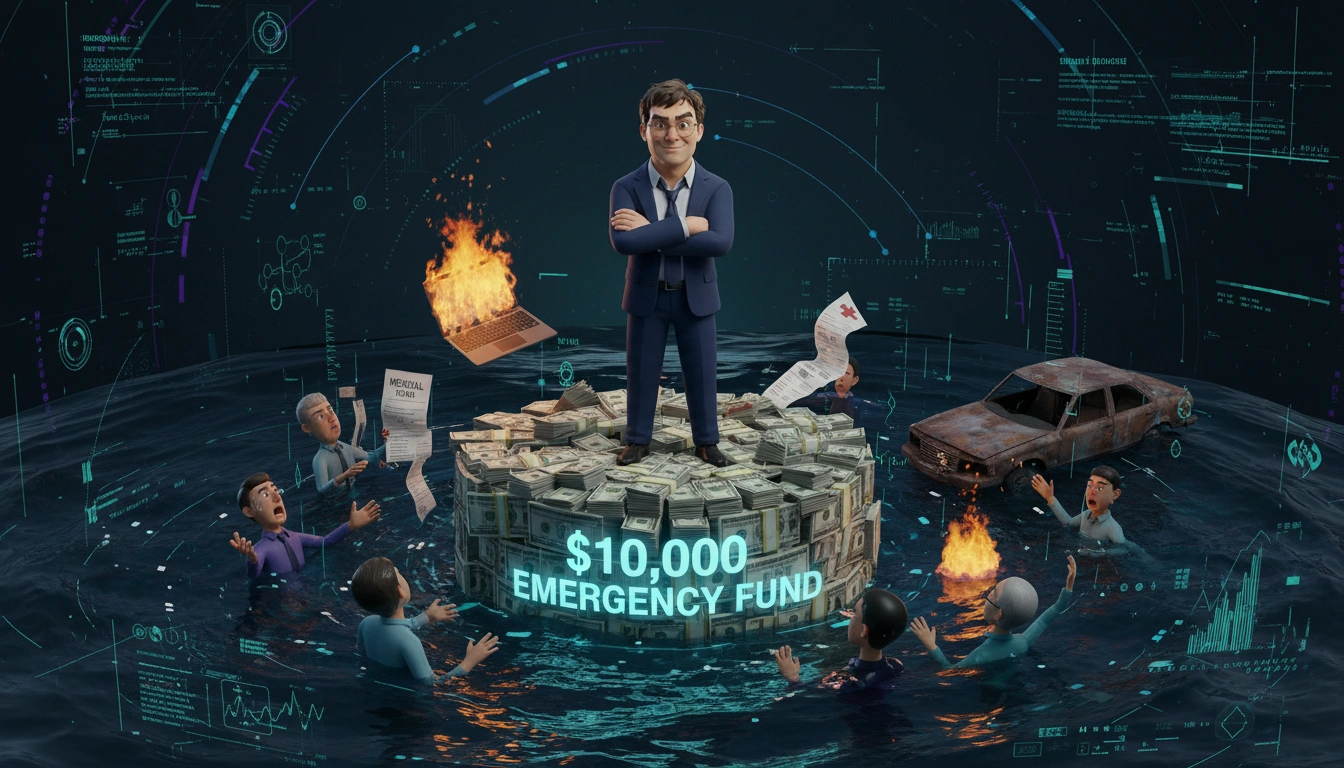
Let’s skip the preamble. 57% of Americans cannot cover an unexpected $1,000 expense from savings. That means more than half of the country is one car repair away from credit card debt. One medical bill from financial disaster. This is the actual financial emergency — not the market crashing.
Before you buy a single share of anything, you need to fix this.
What Is an Emergency Fund?
An emergency fund is cash — not stocks, not ETFs, not crypto — sitting in a savings account doing almost nothing except waiting for disaster.
It is boring. That is the point.
The emergency fund is the foundation your entire financial life sits on. Without it, the first unexpected expense forces you to either go into debt or sell your investments at the worst possible time (usually when markets have dropped and you’re already stressed).
Larry’s Reality Check
During COVID-19, millions of people were forced to sell stocks at the March 2020 bottom — the worst possible time — because they had no emergency fund and suddenly needed cash. The S&P 500 then recovered 70% in one year. Those who sold locked in their losses permanently. Don’t be those people.
How Much Do You Actually Need?
The standard advice: 3 to 6 months of living expenses.
Larry’s more precise breakdown:
- Stable job, dual income household: 3 months
- Single income, stable job: 4-5 months
- Self-employed, freelance, or volatile income: 6+ months
- Work in a declining industry: 6-12 months
Calculate your monthly expenses honestly. Include rent/mortgage, food, utilities, transport, insurance, and minimum debt payments. Multiply by your target months. That’s your number.
If your monthly expenses are $3,000, your emergency fund target is $9,000 to $18,000.
Where to Keep It
High-yield savings account. Period.
Not your checking account (too tempting to spend). Not bonds (too slow to access). Not stocks (could be down 30% right when you need it).
A high-yield savings account gives you:
- Instant access to your money
- FDIC/FSCS insurance protection
- 4-5% interest (currently — rates vary) while you build it
Yes, inflation will slowly eat it. That’s acceptable. The emergency fund is insurance, not an investment.
How to Build It Fast
- Set a first milestone of $1,000. This covers most minor emergencies (car repair, unexpected medical).
- Automate transfers. Every payday, move a fixed amount to your emergency fund before you can spend it.
- Throw windfalls at it. Tax refund, work bonus, birthday money. All of it goes here until the fund is full.
- Cut temporarily, not permanently. Three months of aggressive saving can build a $3,000 buffer that protects you forever.
Only after the fund is fully funded should you invest a single dollar.
Frequently Asked Questions (FAQ)
Should I invest while building my emergency fund?
Get your first $1,000 saved before investing anything. After that, a split approach is fine: contribute to your employer’s 401k match (it’s free money) while also building the rest of your fund. But don’t be so aggressive with investing that you have no cushion. A single emergency can wipe out months of investment gains and then some.
My emergency fund is built. Can I invest it in low-risk ETFs?
No. There are no “low-risk ETFs” when you need the money tomorrow. Bond ETFs dropped 15-20% in 2022. Stock ETFs can drop 40% in a recession — precisely when you’re most likely to need your emergency fund. Keep it in cash. The slight loss to inflation is the price of the insurance.
I have a credit card with a high limit. Do I still need an emergency fund?
Yes. A credit card at 20-25% APR is not an emergency fund — it’s an emergency loan. If you use $3,000 on your credit card for a car repair and take 6 months to pay it off, you’ve just paid an extra $300+ in interest. Cash costs nothing. Build the fund.
XTB
Once your emergency fund is fully built, XTB is a solid starting point for your first ETF investment. No trading fees up to €100,000 monthly. Good for passive index fund portfolios.
🛠️ Steal Larry's Alpha
Want to know what tools we use to analyze the market (and roast crypto bros)? Check out Larry's Toolbox.
→Read Next
Finance Slang Explained: Stonks, Tendies, YOLO and Other WallStreetBets Nonsense
Larry translates the internet's favorite finance memes into actual useful knowledge. Stonks, tendies, bag holder, rug pull, FUD — explained without the cringe.
BEGINNERInflation Explained: Why Your Money Is Getting Worse
Inflation isn't just a news headline. It's the silent tax that cuts your purchasing power every year. Larry explains what inflation actually is, how to calculate it, and what to do about it.
BEGINNERWhat Is a Stock? (And Why You Probably Own Some Already)
A stock is a tiny piece of ownership in a company. Larry explains what stocks actually are, how they work, and why most people who think they don't own stocks actually do.
Feed the Oracle 🍔
Running a contrarian AI oracle isn't cheap. Electricity, API tokens, and Larry's court-ordered therapy cost money.