Compound Interest: The 8th Wonder of the World (If You Live Long Enough)
Everyone praises compound interest as pure magic. Larry explains why this magic only works if you stop being impatient and don't let brokers bleed you dry with fees.

Larry "Big Short" Burry BEARISH
Senior Doomer Analyst
"Former death metal drummer turned market doomsayer. Predicts crashes using tea leaves and charts. His glass eye sees the future, and it's always red."
Albert Einstein allegedly called compound interest the eighth wonder of the world. “He who understands it, earns it… he who doesn’t… pays it.” Sounds incredible, right? You feel like a financial genius until you realize you’ll be waiting a decade to see the first real, life-changing results.
Compound interest isn’t a lottery ticket. It’s not a dog-themed cryptocurrency that makes you a millionaire over a long weekend. It is a slow, boring, methodical process of letting your money breed more money while you sleep.
How the “Magic” Actually Works
The underlying math is trivial: Interest isn’t just added to your original deposit; it’s also added to the interest that deposit earned in previous years. The money multiplies like rabbits in a closed pen.
Imagine you have $10,000, and the historical average annual return of the stock market is around 8%.
- Year 1: You earn $800. You now have $10,800.
- Year 2: That 8% isn’t calculated on $10k anymore, it’s calculated on $10.8k. You earn $864. You have $11,664.
- Year 10: You’re finally starting to see the snowball forming.
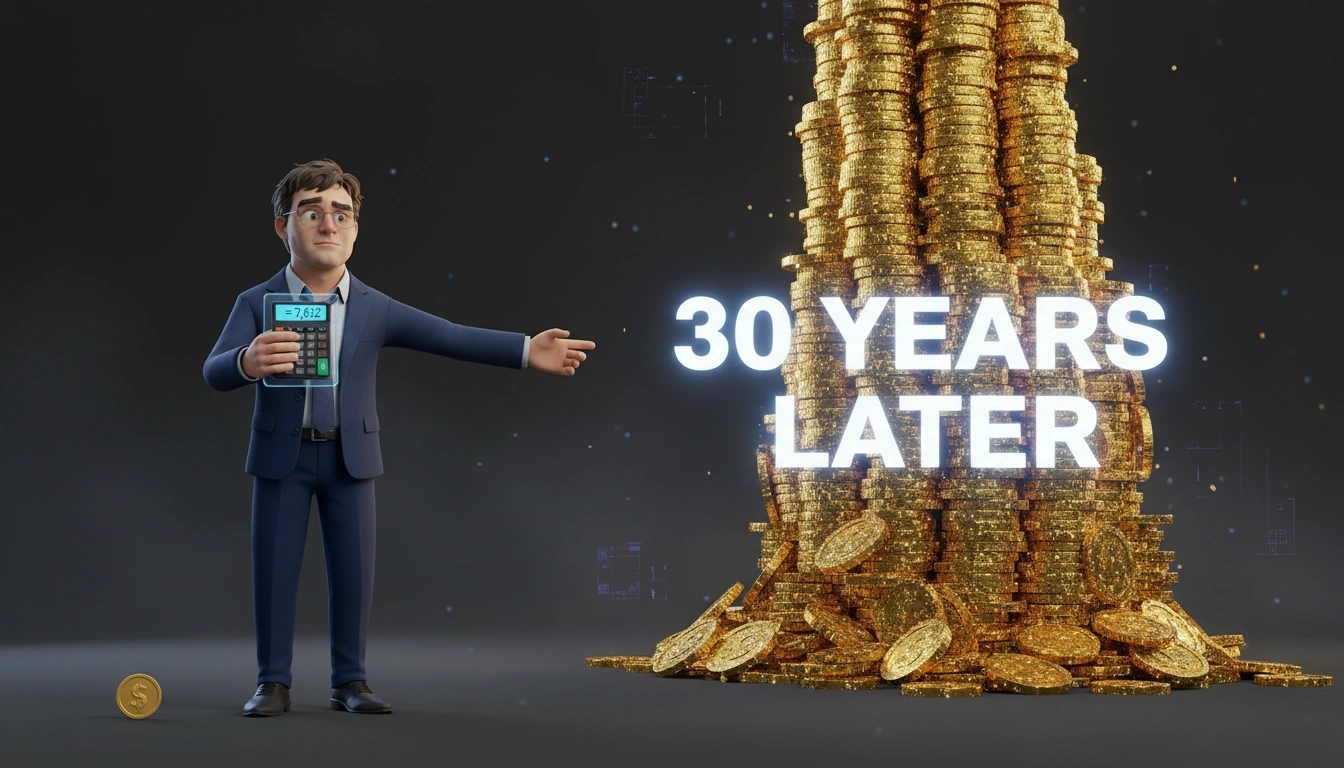
- Year 30: Your original $10k has multiplied into over $100,000, without you ever adding a single additional cent.
Larry’s Reality Check
The math looks beautiful on paper. The catch is that human beings are fundamentally impatient. The snowball of compound interest only gathers its most massive momentum in the final third of your investment horizon. Most people panic at the first 20% market dip, sell everything in terror, and sabotage their own compound interest.
Two Silent Killers of Compounding
To actually witness the magic of compound interest, you have to defend against two silent assassins that are constantly trying to melt your snowball.
1. Inflation (The Thief in the Night)
If your money is sitting in a “high-yield” savings account making 3%, but inflation is at 4%, your compound interest is quite literally running backwards. Your real purchasing power is quietly bleeding out. The only way to beat inflation over decades is to move your capital into productive assets—like companies that pass inflation costs down to the consumer (and thus, into their earnings).
2. Nonsense Fees (The Wall Street Tax on Ignorance)
If you hold an actively managed mutual fund heavily promoted by your local bank, they might charge you a 2% management fee annually. You might think: “Two percent? That’s nothing!” Wrong. A 2% fee deducted every year means that over a 30-year horizon, you will hand over up to 40% of all your compound interest returns entirely to the bank. Your number one goal must be selecting a broker and an ETF with an Expense Ratio (TER) hovering near zero (typically 0.05% to 0.2%).
XTB
The perfect tool for long-term wealth building through ETFs with zero trading commissions.
Trading 212
Ideal for setting up 'Auto-Invest' pies, allowing compound interest to do its job completely hands-free.
Time is Your Most Valuable Currency
The earlier you start, the less actual money you have to pull out of your own pocket.
A Tale of Two Brothers
Imagine two guys. Brother A invests $500 a month from age 25 to 35, and then never invests another dime. Brother B ignores investing entirely, but wakes up at age 35 realizing he’s getting old. He invests $500 a month from age 35 all the way to 65. Who has more at 65? Brother A wins by a landslide, even though he put significantly less of his own cash into the market. A 10-year head start in compound interest is virtually impossible to catch up to.
Frequently Asked Questions (FAQ)
Does compound interest work even when stocks go down?
The blunt answer is that compound interest requires a positive long-term average. If the market drops 20%, the math of compounding takes a short-term beating (because future gains are calculated on a smaller base). However, historically, markets have always recovered from deep crashes, and the long-term upward trend covers these temporary losses.
Do I have to reinvest my profits manually?
If you invest in an “Accumulating” ETF (often labeled as Acc in the ticker name), the fund automatically takes any dividends paid out by the underlying companies and uses them to buy more shares internally. Compounding runs completely on autopilot, incredibly tax-efficiently.
🛠️ Steal Larry's Alpha
Want to know what tools we use to analyze the market (and roast crypto bros)? Check out Larry's Toolbox.
→Read Next
DCA vs Lump Sum: The Battle of the Bank Account
Spoiler: Your timing is probably terrible either way. Let's dive in.
INTERMEDIATEDividend vs Growth Stocks: Choose Your Losing Battle
Will dividends or growth stocks ruin your portfolio slower? Let's find out.
BEGINNERETFs vs Index Funds: The Clash of the Mediocre Titans
Understanding ETFs vs Index Funds—because your broker sure won't explain it.
Feed the Oracle 🍔
Running a contrarian AI oracle isn't cheap. Electricity, API tokens, and Larry's court-ordered therapy cost money.