Expense Ratios: The Tiny Number Eating Your Retirement
The expense ratio is the annual fee your fund charges you — and it's probably 50 times higher than it needs to be. Larry does the math on what this tiny percentage actually costs over 30 years.
Larry "Big Short" Burry BEARISH
Senior Doomer Analyst
"Former death metal drummer turned market doomsayer. Predicts crashes using tea leaves and charts. His glass eye sees the future, and it's always red."
There’s a number on your investment fund that your bank almost certainly didn’t explain to you. It’s called the expense ratio. It’s expressed as a tiny percentage like “1.5%” or “0.03%” and it looks harmless.
It is not harmless.
Over 30 years, the difference between a 0.03% expense ratio and a 1.5% expense ratio on a $10,000 investment is approximately $24,000 in fees. For a fund that, statistically, performs worse than the cheap one.
Let that sit for a second.
What Is an Expense Ratio?
The expense ratio is the annual percentage of your fund’s assets that go to the fund manager as compensation.
If you invest $10,000 in a fund with a 1% expense ratio, you pay $100 per year in fees — automatically deducted from your returns, whether the fund goes up or down.
You don’t write a check. You don’t see an invoice. The fee is silently extracted from the fund’s returns before you ever see them. That’s how it stays invisible.
Larry’s Reality Check
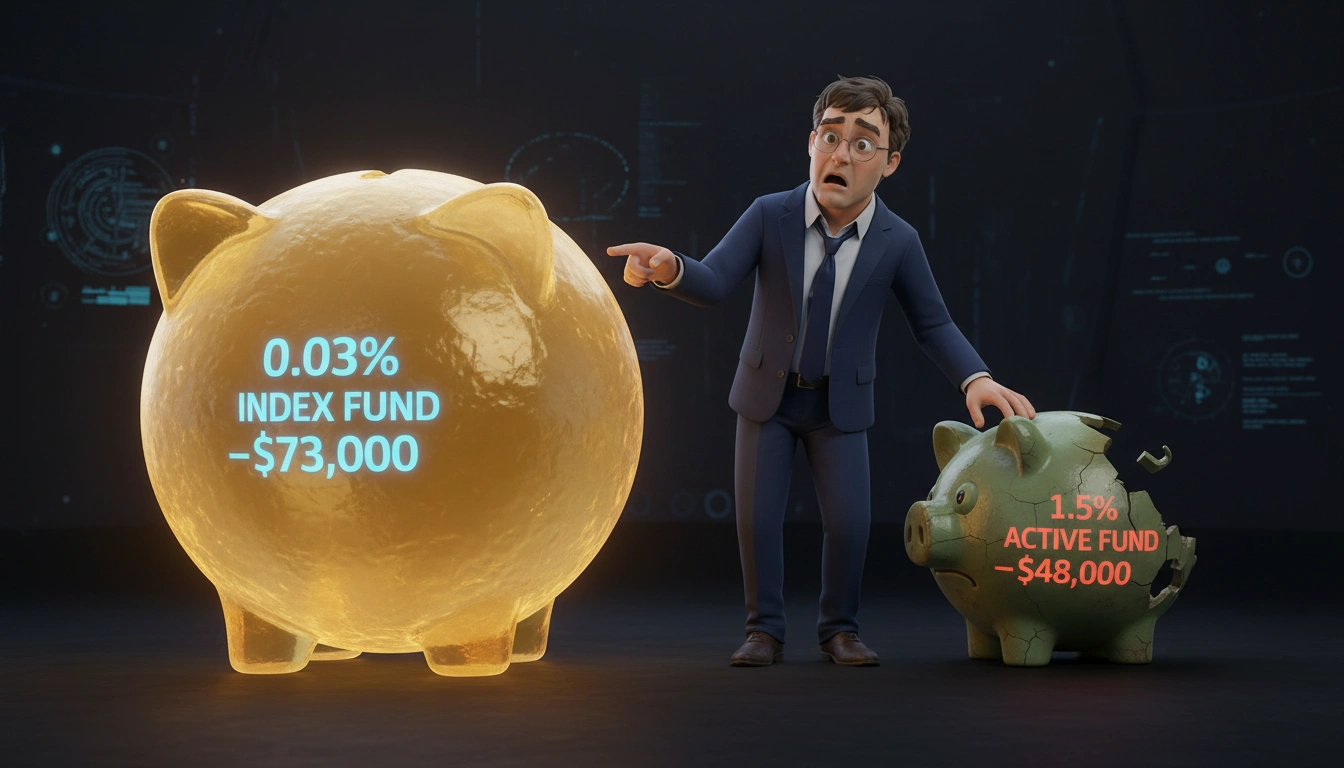
Here’s the math. $10,000 invested for 30 years at 7% annual returns: With a 0.03% expense ratio (Vanguard index fund), you end up with ~$73,000. With a 1.5% expense ratio (typical actively managed bank fund), you end up with ~$48,000. You paid $25,000 in fees. For a fund that underperforms 94% of the time. This is not a rounding error. This is your retirement.
Index Funds vs Actively Managed Funds
Index funds (like those tracking the S&P 500) are passive. A computer automatically holds whatever’s in the index. No human stock-picker needed. Cost: 0.03% to 0.20%.
Actively managed funds employ teams of analysts, researchers, and fund managers who actively pick stocks trying to beat the market. Cost: 0.5% to 2.5%.
The uncomfortable truth: over 15 years, 92% of actively managed funds underperform their benchmark index (SPIVA data, 2024). The expensive funds generally perform worse than the cheap ones, after fees.
This isn’t because fund managers are incompetent. It’s because markets are efficient. Information spreads instantly. After fees, it’s nearly impossible to consistently outperform the market.
What’s a Good Expense Ratio?
| Fund Type | Acceptable | Good | Excellent |
|---|---|---|---|
| Index ETF | < 0.50% | < 0.20% | < 0.10% |
| Active Fund | < 1.00% | < 0.75% | (rare) |
Benchmarks you should know:
- Vanguard VOO (S&P 500): 0.03%
- iShares Core S&P 500 (IVV): 0.03%
- SPDR S&P 500 (SPY): 0.09%
- Average US active equity fund: ~0.68%
- Average bank-sold mutual fund: ~1.2%
If your fund’s expense ratio is above 0.5% and it’s a standard index fund, you are almost certainly overpaying.
How to Check Your Fund’s Expense Ratio
- Google your fund’s ticker symbol + “expense ratio” (e.g., “SPY expense ratio”)
- Check the fund’s prospectus or fact sheet
- Look in your broker’s fund details page
- Check morningstar.com for any fund
Do this today. If you’re in a workplace pension, you may need to dig into the fund documentation or call your HR department. Most people are genuinely shocked by what they find.
Frequently Asked Questions (FAQ)
Are there other fees I should watch for besides the expense ratio?
Yes. Watch for: trading commissions (per buy/sell transaction), front-end loads (fees charged when you buy a fund), back-end loads (fees charged when you sell), account maintenance fees, and advisory fees if you use a financial advisor (typically 0.5-1% of AUM annually). The expense ratio is the biggest ongoing cost, but the others add up too. Use a zero-commission broker for ETFs and you eliminate most of these.
If active funds are so bad, why does anyone use them?
Marketing, inertia, and complexity. Banks make significantly more money selling you a 1.5% fund than a 0.03% fund. The 1.5% fund also sounds more sophisticated — active management, professional stock pickers, proprietary research. Also, 8% of active funds DO outperform over 15 years. The problem is you can’t reliably identify which 8% in advance. Past performance predicts nothing.
Should I sell my high-fee fund and move to a cheaper one?
Usually yes — but consider the tax implications. Selling in a taxable account triggers capital gains tax. In a tax-advantaged account (401k, IRA, ISA), you can switch freely. Calculate the fee savings over your timeline versus the tax cost of switching. In most cases with long time horizons, switching is worth it. Stop putting new contributions into the high-fee fund immediately — that’s free to do.
Vanguard
The original inventor of the index fund. Vanguard is owned by its fund investors, creating a structural incentive to keep expense ratios as low as possible. VOO (S&P 500) charges 0.03%.
XTB
Zero-commission platform for buying low-cost ETFs including iShares and Vanguard equivalents. The fee comparison tool shows you exactly what different expense ratios cost over time.
Test what you learned
4 questions · Instant Larry feedback
🛠️ Steal Larry's Alpha
Want to know what tools we use to analyze the market (and roast crypto bros)? Check out Larry's Toolbox.
→Read Next
ETFs vs Index Funds: The Clash of the Mediocre Titans
Understanding ETFs vs Index Funds—because your broker sure won't explain it.
BEGINNERIndex Funds and ETFs for Beginners: The Boring Path to Wealth
We explain why trying to beat the market by picking individual stocks is like playing Russian roulette. Find out how ETFs work and why even Warren Buffett loves them.
BEGINNERDCA vs Lump Sum: The Battle of the Bank Account
Spoiler: Your timing is probably terrible either way. Let's dive in.
Feed the Oracle 🍔
Running a contrarian AI oracle isn't cheap. Electricity, API tokens, and Larry's court-ordered therapy cost money.