DCA (Dollar-Cost Averaging): A Strategy for People Without Crystal Balls
DCA or Dollar-Cost Averaging. Why it is the bulletproof strategy against the stress of a crashing market and how it helps you stop fearing red numbers on your screen.

Larry "Big Short" Burry BEARISH
Senior Doomer Analyst
"Former death metal drummer turned market doomsayer. Predicts crashes using tea leaves and charts. His glass eye sees the future, and it's always red."
The biggest myth on Wall Street is that to make money, you need perfect timing. You must know exactly when the market has hit “bottom” to buy, and subsequently sell when it hits the “top.” Anyone who tells you they can safely Time the Market is either trying to sell you an absurdly expensive online course, or lying to themselves.
Larry offers you something much more boring and reliable: Dollar-Cost Averaging (DCA).
What is DCA?
It is the most primitive rule of investing. It means you take a fixed amount of money (for instance, $500) and use it to buy your chosen asset (like an S&P 500 ETF) every single month on the exact same day.
It doesn’t matter if interest rates are rising, if there’s a recession, if central banks are printing money like maniacs, or if a global pandemic broke out. You open the app, you click Buy for $500, and you go about your life. That’s the entire strategy.
Larry’s Reality Check
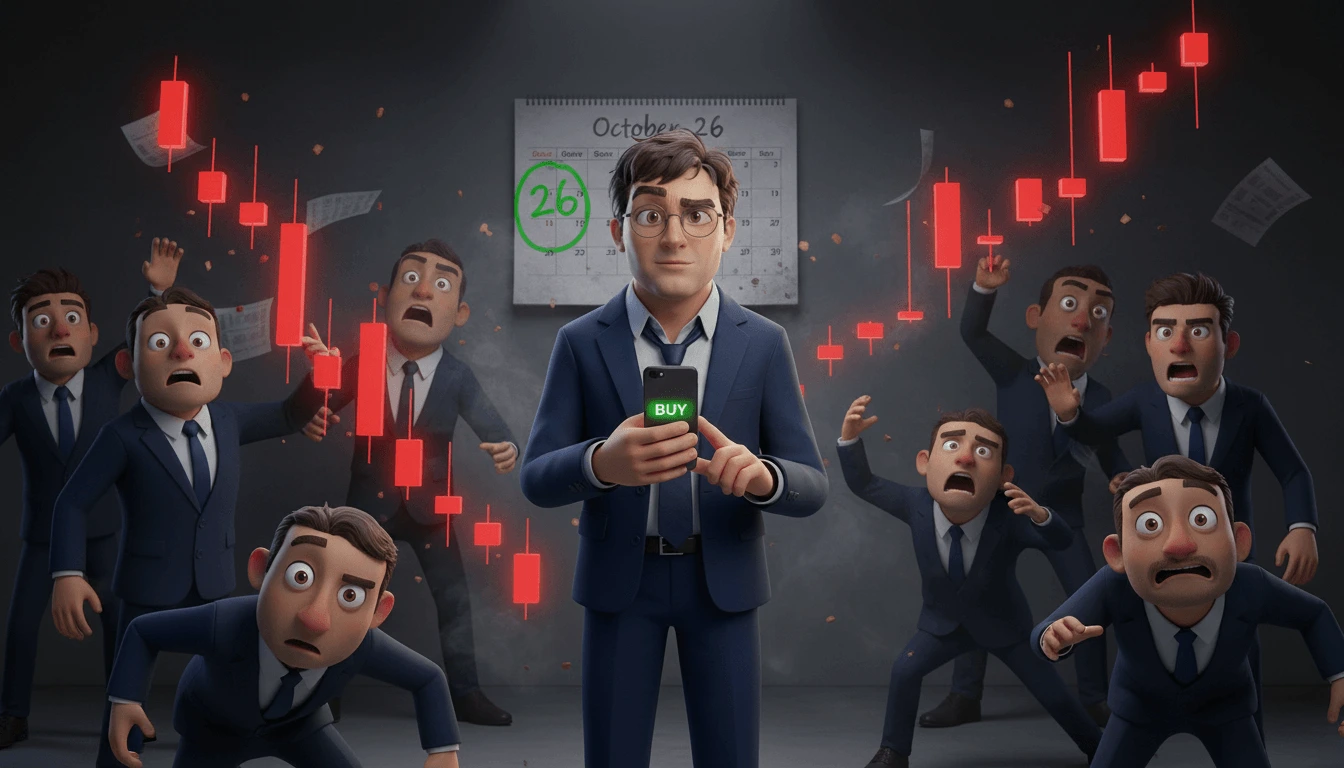
Sounds far too simple, right? The problem isn’t understanding the method; the problem is having the discipline not to break it when the markets turn into a bloodbath. The majority of people who read about DCA eventually panic during a crash, deciding to hide their money under the mattress “for this month.” By doing so, they destroy the entire mathematical advantage of the strategy.
Where is the Hidden Genius of DCA?
The magic of DCA lies in simple math: you are buying with a fixed amount of cash, not a fixed number of shares.
Imagine the stock market as a supermarket:
- When the market is high (Expensive): Your $500 buys fewer units of a given ETF. Excellent, you aren’t overbuying at inflated prices.
- When the market is low (Discount): Blood is in the streets, and prices get slashed. Suddenly, your $500 buys double the amount of ETF units.
The result is that the average purchase price of your asset automatically lowers itself, without you using a single brain cell attempting to forecast macroeconomic trends.
Remove Emotion From the Equation
People perform terribly in the stock market because they let emotions drive their decisions. When it goes up (Bull Market), they suffer from FOMO (Fear Of Missing Out) and buy heavily at the peaks. When the market plunges into a Bear Market, they panic and sell at a severe loss, terrified it will drop to zero.
DCA completely amputates this psychology. It’s an algorithm planted in your head. “Is it the 15th of the month? Payday? Money goes to the broker account. End of discussion.”
Trading 212
The top platform for automated DCA. Allows you to set up 'Pies' that automatically pull money from your card each month and execute the trades without your intervention.
XTB
Offers specialized automated Investment Plans to passively stack capital into broad market ETFs.
Frequently Asked Questions (FAQ)
Is it better to invest $100,000 all at once (Lump-sum) or in smaller chunks using DCA?
Wall Street historical data shows that roughly 66% of the time, a Lump-sum investment beats a DCA strategy. This is because markets historically go up more frequently than they go down, so having more capital exposed immediately is a mathematical advantage. However, would you be psychologically equipped to handle dumping $100k into the market only to watch it drop 30% the following week in a flash crash? If not, spreading it across 10 to 12 months using DCA is the premium (insurance) you pay for a good night’s sleep.
Should I increase my DCA amount during a market crash?
If you have excess cash sitting outside of your emergency fund, and the markets are in a historically massive slump down dozens of percent, slightly increasing your monthly DCA buys (effectively “buying the dip”) can radically amplify your profitability during the eventual recovery.
🛠️ Steal Larry's Alpha
Want to know what tools we use to analyze the market (and roast crypto bros)? Check out Larry's Toolbox.
→Read Next
DCA vs Lump Sum: The Battle of the Bank Account
Spoiler: Your timing is probably terrible either way. Let's dive in.
BEGINNERETFs vs Index Funds: The Clash of the Mediocre Titans
Understanding ETFs vs Index Funds—because your broker sure won't explain it.
BEGINNERHow to Start Investing (And Not Lose Everything on Day 1)
A brutally honest beginner's guide to the stock market. Learn the absolute basics, how brokers work, and why picking individual stocks is a terrible idea for you.
Feed the Oracle 🍔
Running a contrarian AI oracle isn't cheap. Electricity, API tokens, and Larry's court-ordered therapy cost money.